
Construction of Mary-Two-Axe-Earley station (Viau)
- Construction site summary
- Impact on customer trips
- Impact on local residents
- Learn more about the project
- Onglet 5
Construction site summary
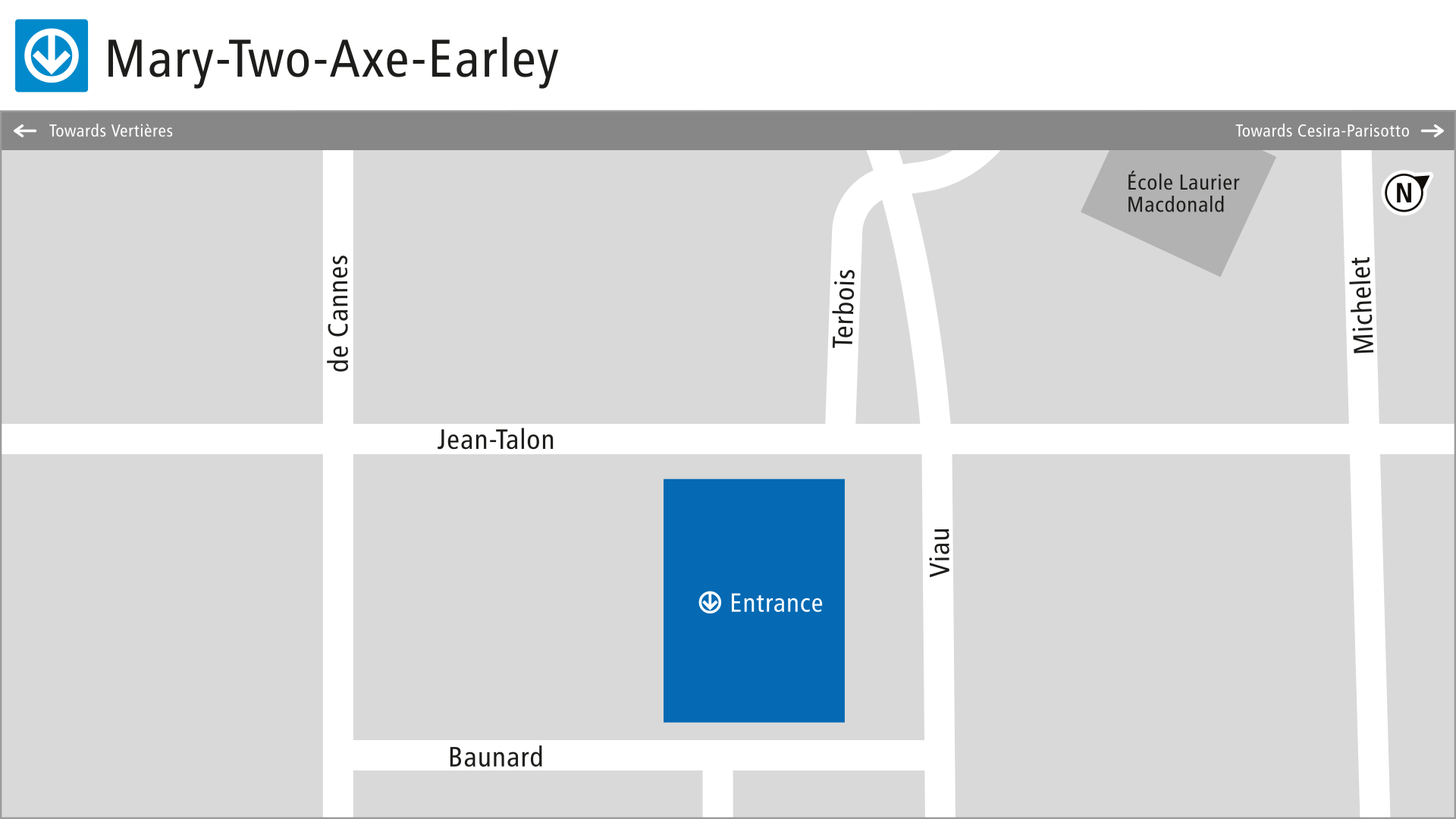
As part of the Blue line project, this work involves the construction of a new universally accessible métro station with one entrance building to be located at the intersection of Jean-Talon and Viau. The entire extension is expected to be commissioned in 2031.
Current steps: Concreting of the vault for the boarding platforms and the tunnel entrances.
Building an underground infrastructure of this scale requires a tremendous amount of work. Here are the main steps required to build the future station:
Step | Status |
Teardown of existing building and soil decontamination | Completed |
Preparatory work (relocation of underground water mains, sewers and cabling) | Completed |
Mobilization and site setup | Completed |
Vertical excavation of the station site | Completed |
Horizontal excavation of the vault for the boarding platforms and the tunnel entrances | Completed |
Shotcrete applied to the walls of the boarding platforms vault and the tunnel entrances | In progress |
Tunnel boring machine work, that will excavate and line most of the tunnel | Upcoming step |
Concreting and construction of new infrastructure | Upcoming step |
Installation of finishing materials, linings and other architectural elements | Upcoming step |
Installation of mechanical and electrical equipment | Upcoming step |
Installation of track system and rails | Upcoming step |
Exterior design and landscaping | Upcoming step |
Testing and commissioning of equipment | Upcoming step |
Impact on customer trips
Due to Jean-Talon street closure, bus stops for lines 141, 188 and 372 are relocated to Bélanger Street. A reserved lane has been set up on Bélanger to keep buses running more regularly.

Impact on local residents
Permanent worksite configuration
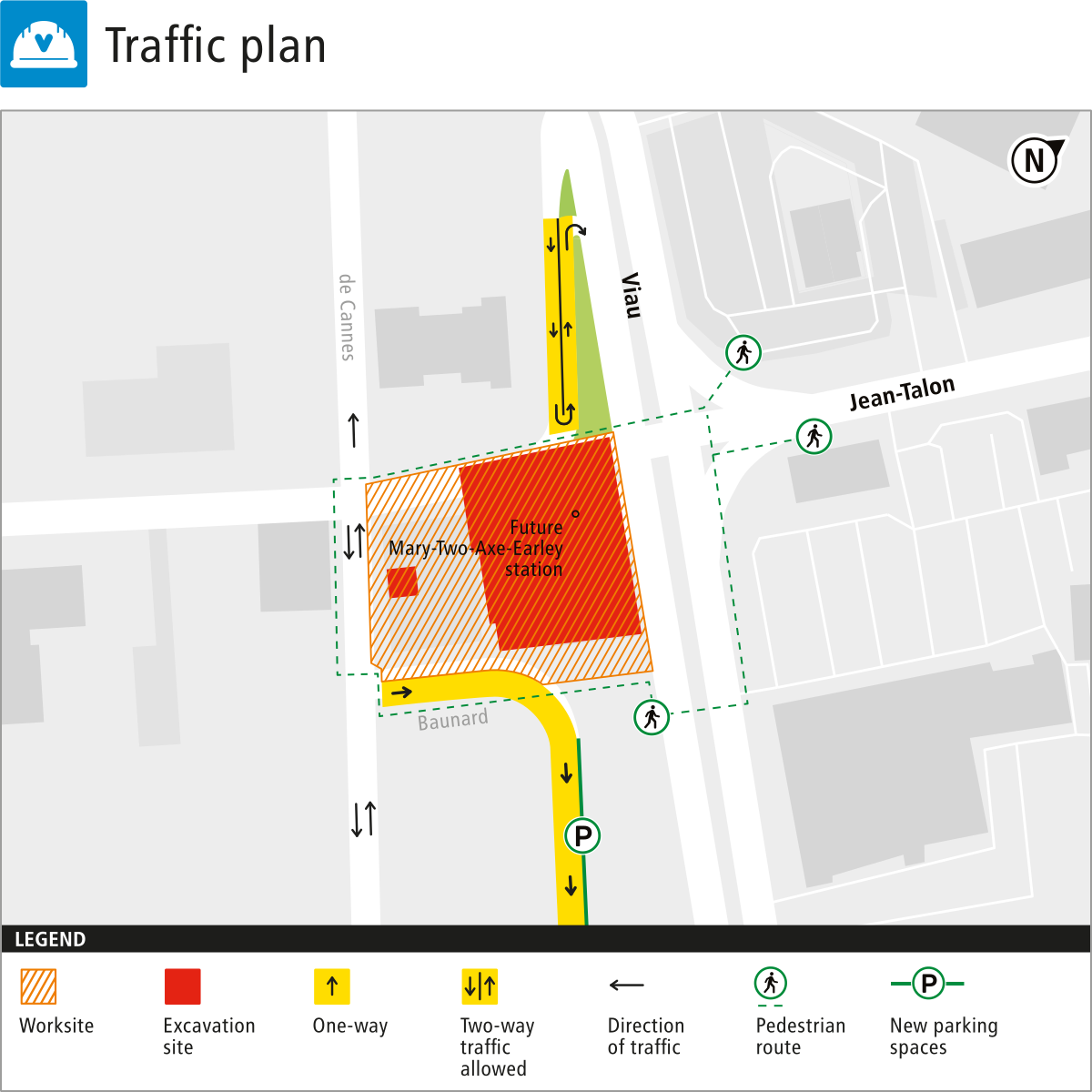
Work on the Blue line project is underway in the area of the future Mary-Two-Axe-Earley station. After completing preparatory work, we have arrived at the configuration that will remain in place for several years.
 Impact for pedestrians
- Only the north sidewalk remains open on Jean-Talon Street for east-west traffic. The south sidewalk is blocked by the construction zone.
- A new secure pedestrian walkway is set up south of the worksite on Baunard Street to provide access to Viau Boulevard.
- Flaggers are present at worksite entrances and exits for pedestrian safety.
- Stay alert, only cross the street at traffic lights and crosswalks, and follow all instructions from the worksite crews.
 Impact on traffic
- Jean-Talon is fully closed between Viau and De Cannes.
- Jean-Talon remains open to traffic both east and west of the worksite.
- De Cannes is two-way traffic south of Jean-Talon Street.
- Baunard is becoming a one-way street heading south to make room for additional parking spaces.
- Terbois becomes a dead end and is set up for two-way traffic. Some parking spaces were removed to allow for this layout.
Good to know
- Access to homes and businesses will be maintained at all times.
- Signage is posted around the worksite to direct pedestrians, cyclists and drivers.
- Worksite trucks circulate on Viau, Jean-Talon and Provencher.
- To reduce the impact on local residents, we have implemented specific mitigation measures. These includes noise walls installed around the worksite perimeter.
Microblasting (completed)
The controlled micro-blasting excavation method was used at the site between the summer of 2025 and the summer of 2026. This technique was used mainly to excavate the station's emergency exit.
Although excavation work using mechanical methods will continue, we can confirm that it will no longer be necessary to use controlled micro-blasting at the construction site of the future Madeleine-Parent station.
For more information
To learn more about this excavation method, consult the Frequently asked questions (FAQ) section on the Blue line project page.
Join your local good neighbour committee!
Do you live near the future Mary-Two-Axe-Earley station or de Lisieux auxiliary building and want to have your say in how the Blue line project worksite will fit into your neighbourhood?
A good neighbor committee has been set up as a space for dialogue between the Blue line extension project team and the local community. We’re currently looking for people who live in the area to complete the committee and represent local residents at a few meetings per year.
Write to us to apply or to find out more.
Learn more about the project
In the coming months, we’ll be starting excavation work to make way for new infrastructure for the Blue line project.
The excavation method will vary depending on the type of work being done. The surface excavation work will involve controlled microblasting, whereas most of the excavation for the underground tunnel will be done using a tunnel boring machine, or TBM. At both types of worksites, there will also be some mechanical excavation. The vibrations produced by the different excavation methods will be measured on an ongoing basis using seismographs. These devices will be installed at various points throughout the excavation zones and will be used to continuously monitor the vibration levels and make sure they fall within legal limits.
Essential preventive measures
To prepare for upcoming excavation work, the STM has tasked ABS with inspecting buildings that meet at least one of the following criteria:
- Located within 75 metres of any surface-level excavation work
- Located within 30 metres of the tunnel axis
The inspections will serve to compile an inventory of the structures surrounding the worksites for the Blue line project. The findings of the inspections will also be used to establish the maximum vibration levels for each site. Although these inspections are a precautionary measure, they are essential in the unlikely event that the work causes any damage.
As a further precaution, any building within 100 metres of a worksite where there will be microblasting will receive a carbon monoxide detector a few weeks before the excavation work starts.
Each building inspection lasts approximately 15 to 30 minutes. Photos are taken of the building interior and exterior. The photos are mostly close-ups of the foundations, walls, ceilings, and floors and serve to document the building’s condition prior to the start of the excavation work.
The pre-construction inspection is a common precautionary measure for major construction sites. It protects you in the unlikely event that your property suffers any damage during work on the Blue line project.
Controlled microblasting is used on several major STM worksites, depending on the type of rock to be excavated. To learn more, watch the video in the FAQ section of our Blue line project page.
In the fall of 2024 and 2025, urban forestry work will take place around the Blue line project worksites. Trees that interfere with the construction sites will be protected, replanted, or cut down. Our team of forest engineers, landscape architects, urban planners, and sustainable development experts has carefully planned these interventions to preserve as many trees as possible.
The goal is to replant the trees wherever possible. Soverdi, the not-for-profit organization overseeing the replanting process, will monitor and care for the trees after they are transplanted to ensure their survival. Trees that can’t be replanted due to their size or condition will be recycled into wood chips, firewood or compost depending on the quality of the wood. The health and species of the trees will also help determine which ones need to be cut down, based on whether they are diseased, subject to borer infestations, or invasive, among other factors.
Ultimately, Blue line project sites will be revegetated and several hundred new trees planted, for a stronger, healthier canopy. For every tree replanted or cut down, we will plant more than two in their place.
.
These organizations are collaborating on the project’s phasing strategy so that all the work lines up to keep local travel running smoothly and ensure good management of their investments. During the excavation, the City of Montréal and other stakeholders will take the opportunity to upgrade underground infrastructure.
The preparatory work involved relocating urban public utilities, giving us free rein to begin the massive excavation that will be needed to build the new métro station. The utilities that needed to be relocated include water pipes, sewers, and underground conduits and cabling.
Projects like the Viau area preparatory work need to be planned months in advance. Together, our experienced technicians, engineers and project managers pool their knowledge of a variety of disciplines, including civil engineering, structure, electricity, building mechanics, geotechnics, traffic maintenance and sustainable development.
Our design, project management and follow-up teams are putting their expertise to good use in the east end of the city, and all this is just the beginning!
let's chat
Public participation
Information sessions, talks, activities, good neighbour committees: our team wants to meet you!
Information booth
At Le Boulevard Shopping Centre
More about the Blue line project
Contenu de l'onglet 5
The project in images
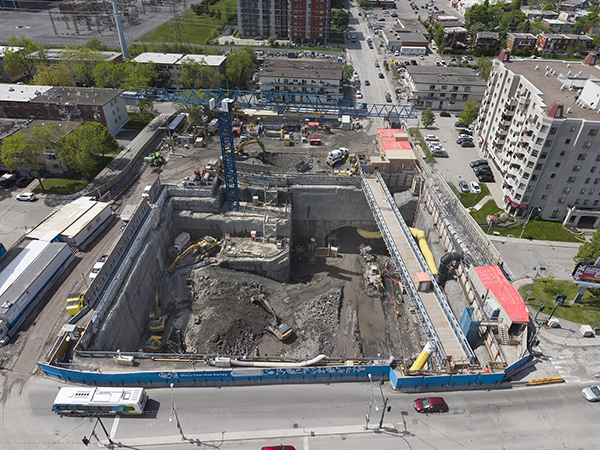
The construction site in May 2026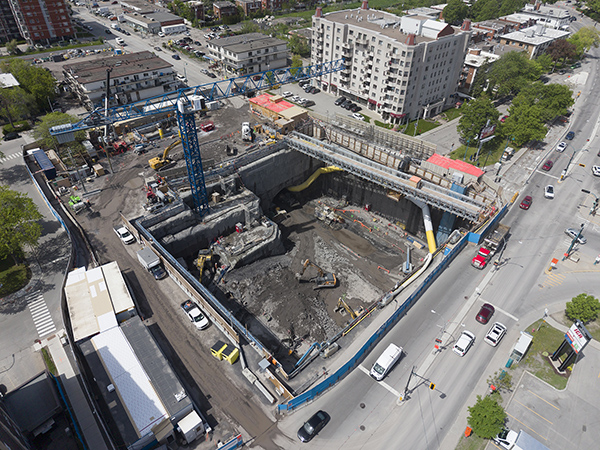 The construction site in May 2026
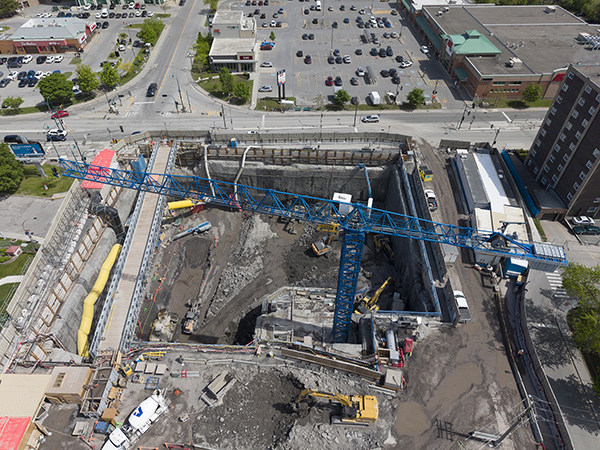 The construction site in May 2026
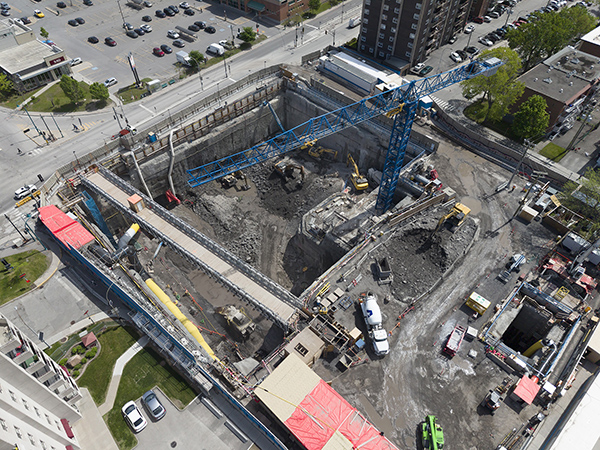 The construction site in May 2026
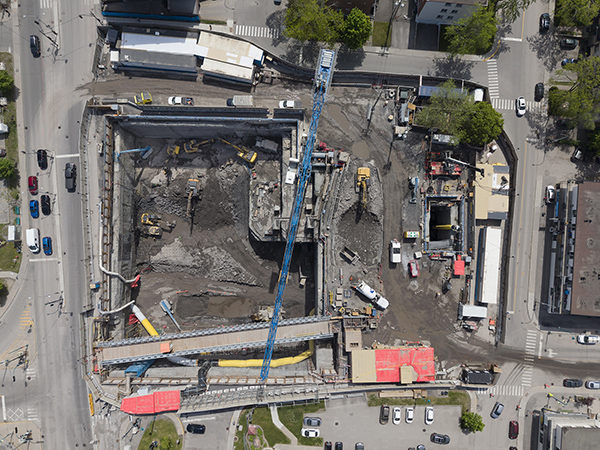 The construction site in May 2026
 Vertical excavation at the site in January 2026
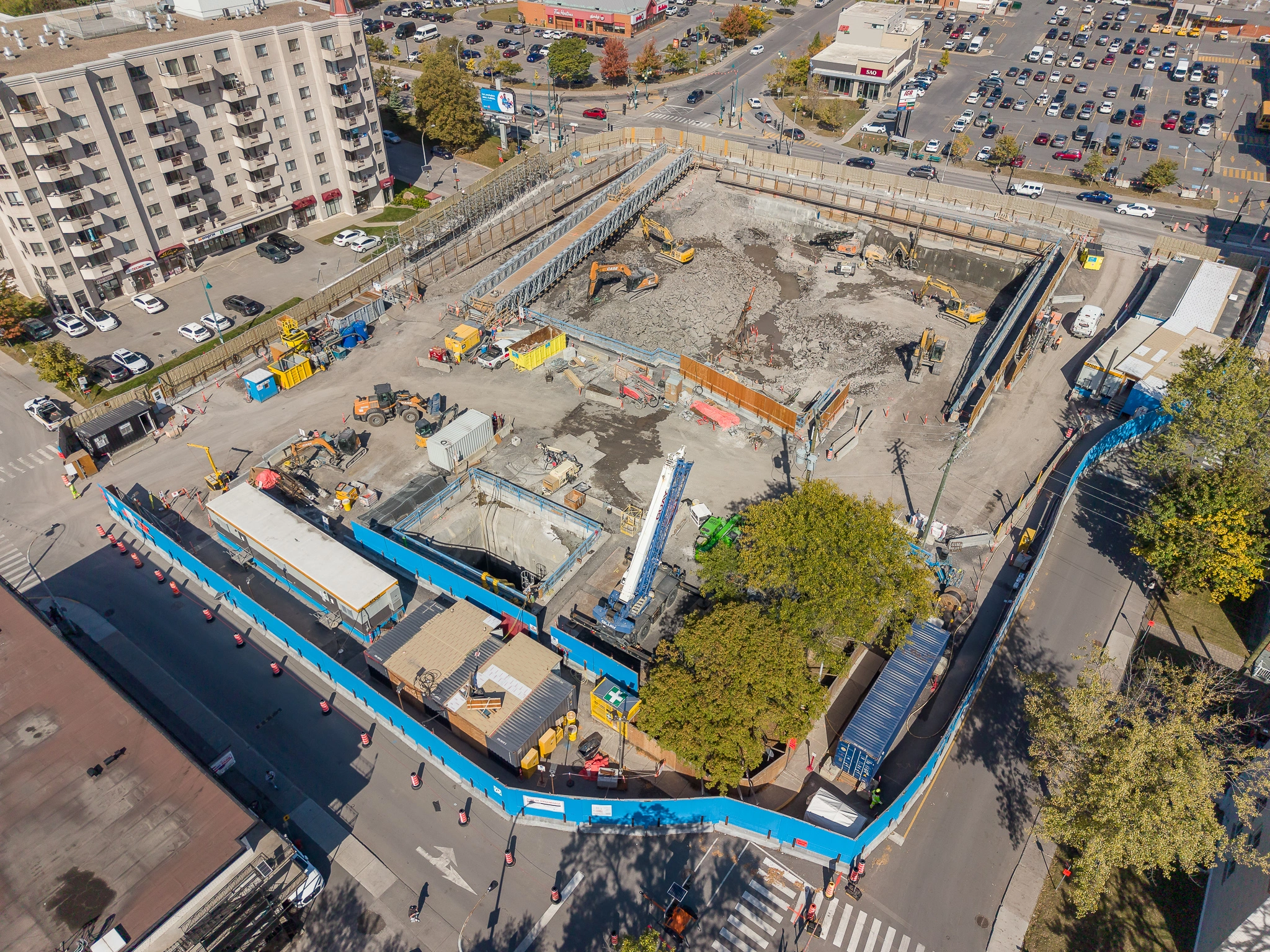 Vertical excavation at the site in October 2025
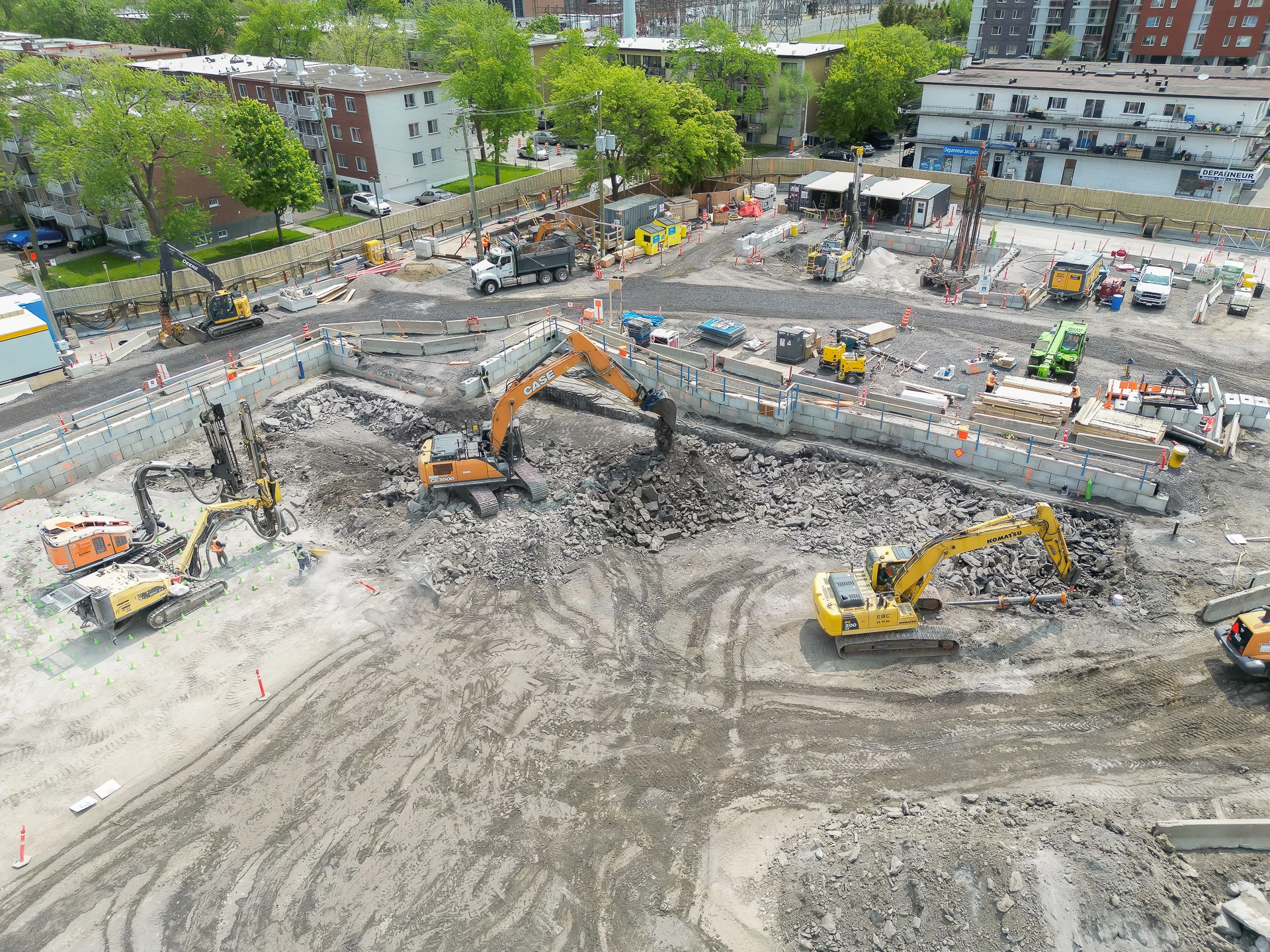 Drilling work at the site in June 2025
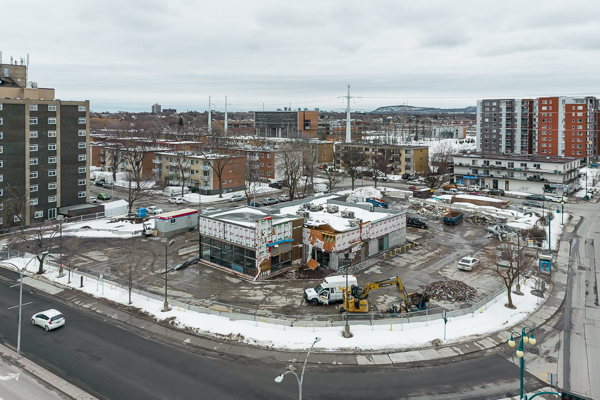 The old building at the Mary-Two-Axe-Earley site was demolished in winter 2023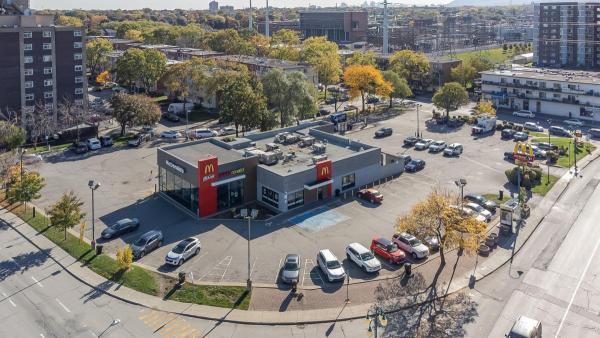
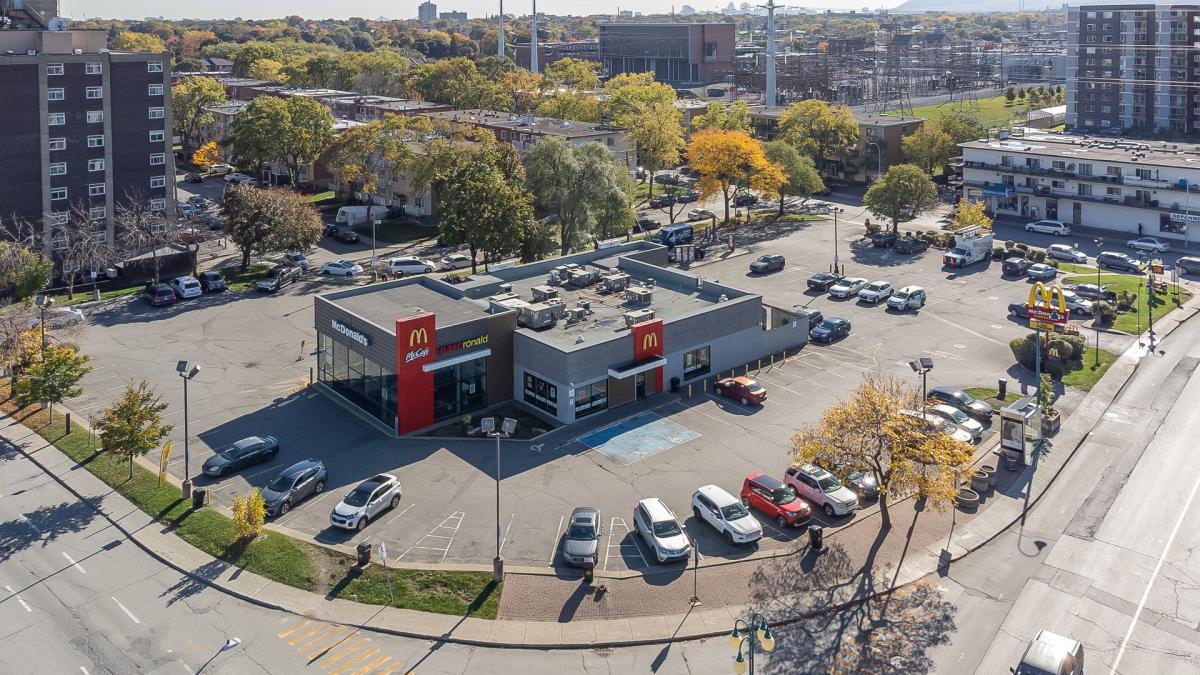
Site of the future Mary-Two-Axe-Earley station at the corner of Jean-Talon and Viau Boulevard
The Blue line project follows in the wake of the Déclaration du gouvernement du Québec et de la Ville de Montréal to revitalize Montréal East. Many projects are underway to give a new impetus to this sector. Increased mobility, economic development, and improved living environments are at the heart of this ambitious project. For more information, see Québec.ca/RevitalisationEstMontreal (in French only).