
Progress of Lisette TBM
September 2026 – Lisette tunnel boring machine has now reached the halfway point between Vertières station (Pie-IX) and Mary-Two-Axe-Earley station (Viau). It has tunnelled approximately 380 m since its launch. It is currently operating at a depth of 30 m and is expected to reach the western end of Mary-Two-Axe-Earley station (Viau) sometime in October.

The machine is about to reach its cruising speed after completing multiple stages of assembly, testing and adjustment that have led to its final configuration.
Tunnel excavation and concreting
Our tunnel boring machine (TBM), custom-built in Germany for the Montreal métro, was delivered to the Blue line project site in fall 2025.This massive rotary boring machine is gradually beginning its 4.6-kilometer eastward journey, from the future Vertières station to the future Anjou station, a first in the Montreal metro system.
Over the coming months, the tunnel boring machine will pass through the cross-passages of the intermediate stations before emerging at the future Anjou station (west entrance) in early 2028.
A real underground factory
With an impressive diameter of 9.7 metres, the TBM, named Lisette, is the largest ever used in Quebec! It will both excavate the rock and build the tunnel walls over a distance of 4.6 kilometres, at a depth ranging from 18 to 40 meters.
Learn how the tunnel boring machine works in this video (in French only)

Technical specifications
- Manufactured in Schwanau, Germany
- Length: over 135 meters
- Weight: over 2,000 tons
- Distance to be covered: 4.6 kilometers
- Excavation speed: Average rate of 10 to 15 meters per day
- Number of segments to be installed: over 14,300 precast concrete segments
- Tunnel diameter: 8.6 meters (after segments are installed)
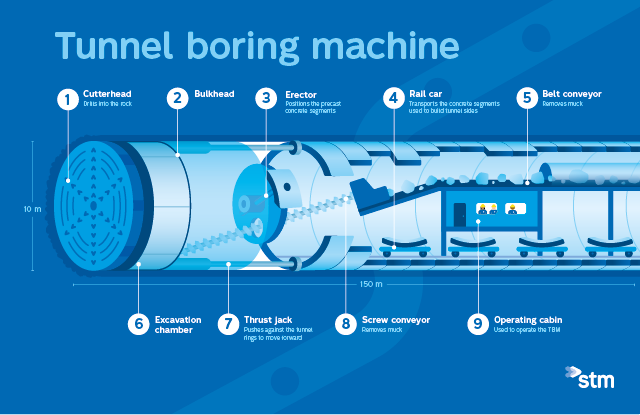
How it Works
- Rotating head: The front of the TBM is a large wheel with cutting discs (1) or cutting tools. It spins to destroy the rock or soil by breaking it up.
- Extraction of materials: Excavated materials are transported to the rear of the machine via a screw conveyor (5) or auger (8). This material will then be removed from the tunnel by conveyor belts.
- Tunnel lining: Just behind the cutting head (3), the tunnel boring machine installs voussoirs (pre-cast concrete segments) to form the lining of the tunnel. This immediately stabilizes the walls and allows the tunnel work to continue safely.
- Progression underground: The tunnel boring machine moves forward thanks to hydraulic cylinders (7) that rest on the already installed liner. It pushes the cutting head forward as it continues to drill.
- Guidance and control systems: Sensors and GPS systems can accurately track the path of the tunnel. The crew in the operating cabin (9) controls the speed, pressure, and cut parameters.
There are many benefits to using a tunnel boring machine. It is faster, more efficient and more durable than other conventional mechanical excavation methods. In addition to keeping the tunnel on schedule, we project that the tunnel walls will be much more watertight thanks to the precast concrete rings. The tunnel on this new section of the Blue line will have a 100-year lifespan. We’re powering the machine with electricity to make the project much greener.
The former Saint-Michel quarry, located very close to the construction site. The rock will belong to the City of Montreal, which will be able to reuse it for future developments.
The successful bidder (MBH) owns the machine and not the STM. For now, the plan is that once it reaches Anjou, the TBM will be dismantled piece by piece for shipment back to Germany, where some of the components can be reused for other projects.
The tunnel boring machine will build 4.6 kilometres of the 6 kilometres of tunnel required for the Blue line extension. The rest of the tunnel will be excavated using a cutter, a more traditional method of mechanical excavation.
The tunnel boring machine was made in Schwanau, Germany, then transported in pieces, first to Rotterdam, the Netherlands, then by boat to Montréal, and finally to the site of the future Vertières station in October 2025.

Upon arriving at the Port of Montreal, the tunnel boring machine was transported in pieces to the site of the future Vertières station. This large-operation carried out mainly at night to minimize disruptions, required transport due to the dimensions and weight of several components.
Oversized parts were transported using 13-axle rolling platforms, while the heaviest parts were moved using self-propelled modular conveyors. A total of 86 packages were delivered within a few weeks.
A tunnel boring machine named Lisette
Naming a TBM is a longstanding tradition in major infrastructure projects worldwide. According to this custom, the machine is symbolically placed under the protection of a godmother before it starts digging. Following a public vote in March, the tunnel boring machine was named Lisette in honour of Lisette St Onge, who in 1981 became Montréal’s first female metro operator.
Lisette, a pioneer in the history of public transit
In 1980, Lisette St Onge (then known as Lisette Renaud) was hired as a bus driver by the Montreal Urban Community Transportation Commission (CTCUM, now the STM). At the time, there were barely fifteen women behind the wheel; the first female driver had been hired three years earlier.
A few months later, Lisette learned that the metro was looking for new operators. Intrigued, she decided to try her luck, and her application was accepted. Encouraged by her colleagues, she became, in the spring of 1981, the first female metro operator in Montreal.

Lisette St Onge
First female métro operator in Montréal
“I loved my job as a métro operator. I never thought I would have the opportunity to become the godmother of the tunnel boring machine for the blue line extension.”
It took more than six years before a second woman took the plunge and became an operator. Lisette benefited from a supportive work environment made up of kind, respectful colleagues who welcomed her warmly.
Now retired, she has fond memories of her career, particularly of representing women in non-traditional roles at the STM in various forums.
The process
Last January, we launched a call for proposals among our employees and partners to gather suggestions of living Québec women who have made significant contributions to fields related to this project, such as engineering, sustainable development or public transit.
A jury selected five finalists based on various criteria, including relevance, alignment with the project’s values and the impact of the candidate’s work. In addition to lending her name to the TBM, the chosen godmother will have the opportunity to follow the project’s progress and visit the crews on site.
The public had the opportunity to choose their favourite godmother. Lisette St Onge was selected from among four other exceptional women: Florence Junca-Adenot, Geneviève Boisjoly, Louise Millette and Michèle Thibodeau-DeGuire.
This initiative will strengthen the bond between this major project and the communities it will serve.
The TBM's godmother was chosen after a public vote held from March 9 to 22, 2026, which attracted nearly 9,000 participants. Thank you for your participation.
To thank you for helping to choose the tunnel boring machine’s godmother, three people were selected at random and invited to attend the machine’s launch event at the Vertières construction site, where the godmother’s identity was revealed. Congratulations to our winners: Damaris Rose, Diego Orlando Abril Frade, and Nicolas Gaudreau.
Congratulations to Lisette St Onge, who was selected from among four other exceptional women: Florence Junca-Adenot, Geneviève Boisjoly, Louise Millette and Michèle Thibodeau-DeGuire. Discover the inspiring journeys of the four other candidates.

Florence Junca-Adenot
Transportation and Urban Planning Specialist
Professor at UQAM and the first CEO of the Agence métropolitaine de transport, she has dedicated her career to urban development, public transportation, real estate, education and culture.
Geneviève Boisjoly
Transportation Planning Specialist Engineer
Professor of civil engineering at Polytechnique, she specializes in transportation planning and sustainable mobility. Her research explores how our transportation networks shape our cities, our travel habits, and our life quality.


Louise Millette
Driven engineer and professor
Engineer and dedicated professor, she is a pioneer in sustainable development. She was the first woman to head a department at Polytechnique. She helps to foster a culture of sustainable development within the institution.
Michèle Thibodeau-DeGuire
Engineer and Board Member
As the first woman to graduate with a degree in civil engineering from Polytechnique, she became the first female consulting engineer in Quebec. At the helm of Centraide of Greater Montreal for more than twenty years, she achieved numerous successes and received many prestigious awards.

Contenu de l'onglet 3
Contenu de l'onglet 4
Contenu de l'onglet 5
The projet in images
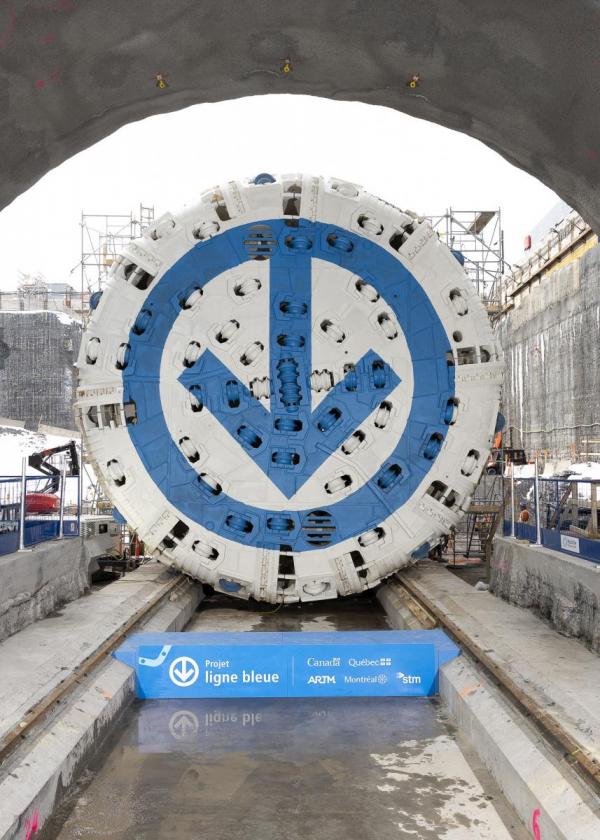
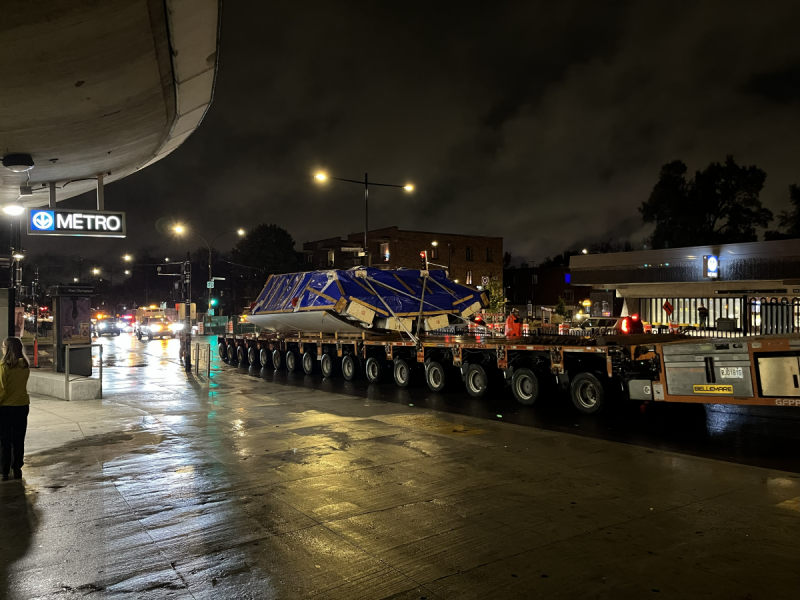
Transportation of a tunnel boring machine component weighing 86 tons to the future Vertières station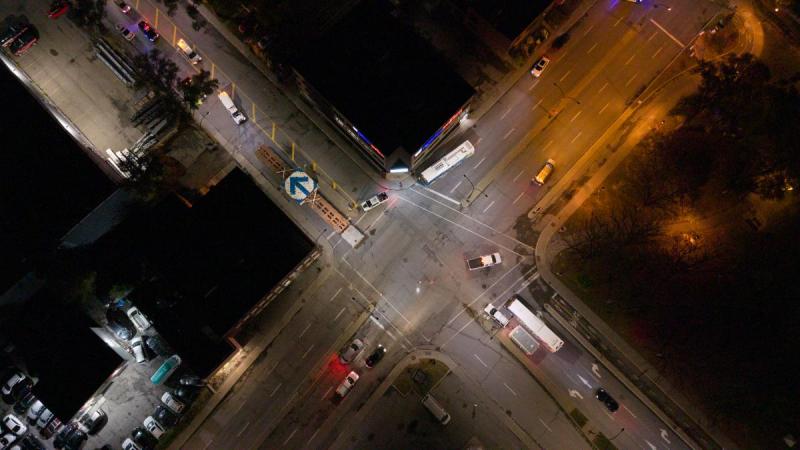
Transportation of the cutterhead center of the tunnel boring machine (photo credit: SNAPEePHOTO)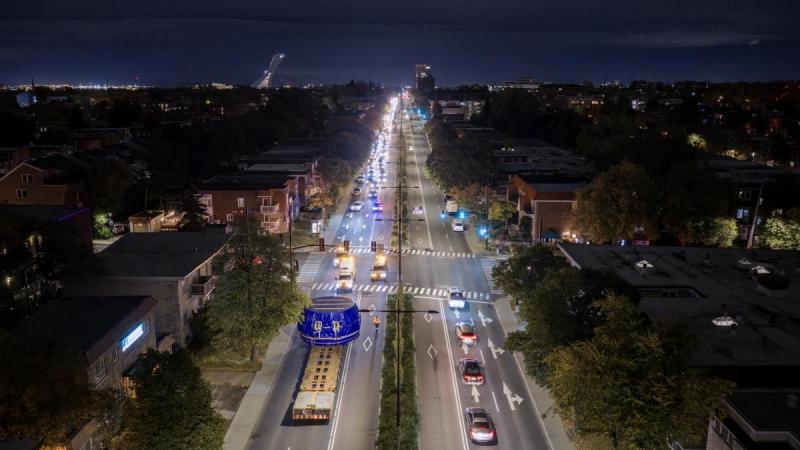 Transportation of the largest tunnel boring machine component weighing 204 tons (photo credit: SNAPePHOTO)
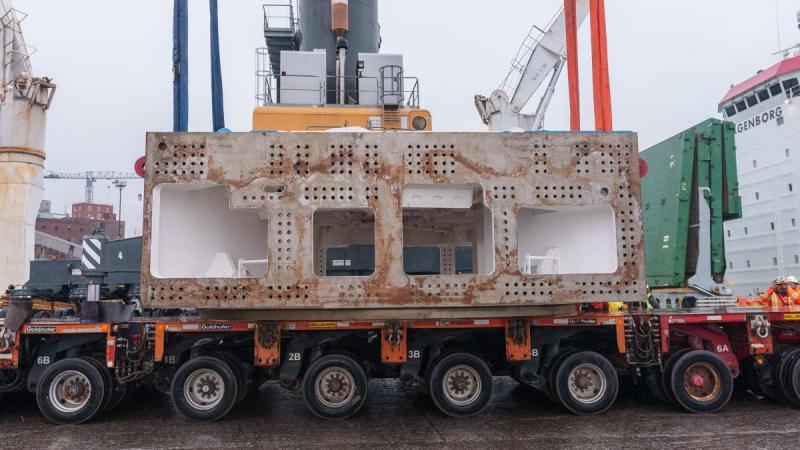 Unloading of the tunnel boring machine in parts at the Port of Montreal (photo credit: SNAPePHOTO)
The blue line extension project follows in the wake of the Déclaration du gouvernement du Québec et de la Ville de Montréal to revitalize Montréal East. Many projects are underway to give a new impetus to this sector. Increased mobility, economic development, and improved living environments are at the heart of this ambitious project. For more information, see Québec.ca/RevitalisationEstMontreal(in French only).