
 My Alerts
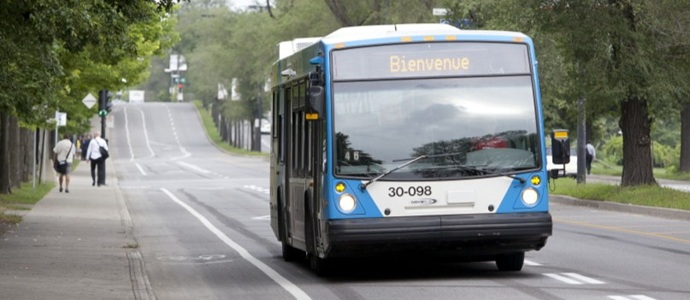
Your routes have changed
You can check the bus routes schedules that have been in effect since May 18. Use our trip planner by selecting the date of your choice.
A redesigned bus network
To make your trips easier, we’ve updated the bus network in the Centre-Nord and the West Island to better connect buses, the métro, trains, taxibuses and the REM.
The result is more direct lines to your destinations, simplified routes, better coverage and expanded service in the evenings and on weekends.
This new network serves six boroughs and nine linked cities, making your trips smoother.

- Redesign of the Centre-Nord and West Island bus network
- Key principles and steps
- Activities and Events
- Media Library
- Your questions
Redesign of the Centre-Nord and West Island bus network
The arrival of the Réseau express métropolitain (REM) marks a new turning point in public transit in Greater Montreal. The Centre-Nord and West Island bus network has been redesigned to better serve your neighbourhood and connect with it.
Key figures
- +80 bus lines making it easier for over 375,000 people to get around
- 3,411 stops in service including 246 new ones to bring us closer to you
- 14,000 simplified transfers with one less bus to take
- 29,000 people can now reach a high-frequency bus line within a 750-metre walk
- 67,000 trips shortened by at least 5 minutes
Cities and boroughs
The bus network was redesigned in six boroughs and nine linked cities, representing nearly 40% of the island of Montreal. Connection to the REM, more direct lines, simplified routes, better coverage, extended service in the evenings and on weekends—the network has changed to make getting around easier and more enjoyable.
The redesign of the bus network in Ahuntsic-Cartierville included the creation of a continuous east-west link on Boulevard Henri-Bourassa to the Bois-Franc REM station.
Since the redesign:
- 18 new bus stops in the area
- 16% of public transit trips starting in Ahuntsic-Cartierville are shortened by at least 5 minutes
- 104,064 residents now live within a 10-minute walk of a frequent bus line
See the list of modified lines
54 Charland / Chabanel
Trips are added Monday through Friday when an increase in ridership is expected.
Eastbound
To see the full Monday through Friday schedule, click here.
Westbound
To see the full Monday through Friday schedule, click here.
Service adjustments on line 79 Gouin Monday through Friday
Eastbound
Service is adjusted between 6:15 a.m. and 8:30 a.m. and between 2:15 p.m. and 4:30 p.m. Buses run every 15 minutes between Gouin / Grenet (54319) and the Henri-Bourassa station (54127).
To see the full Monday through Friday schedule, click here.
Westbound
Service is adjusted between 6:45 a.m. and 8:30 a.m. and between 2:30 p.m. and 6 p.m. Buses run every 15 minutes between Henri-Bourassa station (54127) and Pierrefonds-Roxboro station (62577).
To see the full Monday through Friday schedule, click here.
The redesign of the bus network in Baie-D’Urfé improves access to the REM from the Anse-à-l’Orme station to the industrial area and simplifies express service along the Highway 20 corridor for residential areas.
Since the redesign:
- 10 new bus stops added in the area
- 15% of public transit trips starting at Baie-D’Urfé are shortened by at least 5 minutes
- 4,150 jobs newly served by bus and taxibus services
The redesign of the bus network in Beaconsfield improves access to the REM, particularly thanks to the Beaurepaire taxibus service and better organization of the bus lines, in addition to enhancing express service along Highway 20.
Since the redesign:
- 15 new bus stops in the area
- 15% of public transit trips starting in Beaconsfield are shortened by at least 5 minutes
- 10,097 residents now live within a 10-minute walk of a frequent bus line
See the list of modified lines
See the answers to your questions about this sector (in French)
201 Saint-Charles
Service on the line has been extended with the addition of two evening departures in each direction. To view the scheduled timetable for Monday through Friday:
In Côte-des-Neiges, the redesign improves network performance with a new north-south link, optimizes the number of stops on Line 161 and increases bus frequency on key lines.
Since the redesign:
- 36 new bus stops added in the area
- 12% of public transit trips starting in Côte-des-Neiges are shortened by at least 5 minutes
- 159,843 residents now live within a 10-minute walk of a frequent bus line, an increase of 3%
The redesign of the bus network in Dollard-des-Ormeaux connects the bus network to REM stations more efficiently and increases service frequency on Boulevard Saint-Jean and Boulevard des Sources.
Since the redesign:
- 91 bus stops across the entire area
- 40% of public transit trips starting in Dollard-des-Ormeaux are shortened by at least 5 minutes
- 9,844 residents now live within a 10-minute walk of a frequent bus line
In Dorval, the redesign of the bus network simplifies service along the Highway 20 corridor, improves access to the REM, increases bus frequency on Avenue Dawson and connects areas separated by Highway 20 more efficiently.
Since the redesign:
- 6 new bus stops in the area
- 14% of public transit trips starting in Dorval are shortened by at least 5 minutes
- 9,054 residents now live within a 10-minute walk of a frequent bus line, an increase of 114%
See the list of modified lines
225 Hymus
An additional westbound trip is added in the evening. To view the scheduled timetable for Monday through Friday, click here.
In Kirkland, the redesign of the bus network improves access to the REM thanks to a simplified network with more frequent service on major roadways.
Since the redesign:
- 6 new bus stops in the area
- 50% of transit trips starting in Kirkland are shortened by at least 5 minutes
- 1,916 residents now live within a 10-minute walk of a frequent bus line
See the list of modified lines
201 Saint-Charles
Service on the line has been extended with the addition of two evening departures in each direction. To view the scheduled timetable for Monday through Friday:
The redesign of the bus network in L’Île-Bizard–Sainte-Geneviève optimizes access to the REM thanks to extended lines on the island and a centralized service to the Fairview–Pointe-Claire station.
Since the redesign:
- 26 new stops in the area
- 35% of public transit trips starting in L’Île-Bizard–Sainte-Geneviève are shortened by at least 5 minutes
- 3,361 residents now live within a 10-minute walk of a frequent bus line, an increase of 13%
See the list of modified lines
201 Saint-Charles
Service on the line has been extended with the addition of two evening departures in each direction. To view the scheduled timetable for Monday through Friday:
The redesign of the bus network in Mont-Royal improves access to the REM with the introduction of a new daily service in the Namur–De la Savane area and optimizes certain lines serving residential neighbourhoods.
Since the redesign:
- 5 new bus stops in the area
- 35% of public transit trips starting in Mont-Royal are shortened by at least 5 minutes
- 11,544 residents now live within a 10-minute walk of a frequent bus line, an increase of 19%
The redesign of the bus network in Outremont increases frequency on Line 161, modifies Line 160 to serve the MIL campus and connects Avenue Bernard directly to the Laurier station.
Since the redesign:
- 9 new bus stops in the area
- 15% of public transit trips starting in Outremont are shortened by at least 5 minutes
- 24,696 residents now live within a 10-minute walk of a frequent bus line
In Pierrefonds-Roxboro, the redesign of the bus network improves access to the REM and increases the frequency of lines on Boulevard Pierrefonds, Boulevard Saint-Jean and Boulevard des Sources.
Since the redesign:
- 8 new stops in the area
- 35% of public transit trips starting in Pierrefonds-Roxboro are shortened by at least 5 minutes
- 18,247 residents now live within a 10-minute walk of a frequent bus line
See the list of modified lines
201 Saint-Charles
Service on the line has been extended with the addition of two evening departures in each direction. To view the scheduled timetable for Monday through Friday:
The redesign of the bus network in Pointe-Claire improves access to the REM and connections between neighbourhoods and major hubs, while simplifying express service along the Highway 20 corridor.
Since the redesign:
- 56 new stops in the area
- 21% of public transit trips starting in Pointe-Claire are shortened by at least 5 minutes
- 5,425 residents now live within a 10-minute walk of a frequent bus line, an increase of 140%
See the list of modified lines
225 Hymus
An additional westbound trip is added in the evening. To view the scheduled timetable for Monday through Friday, click here.
The redesign of the bus network in Sainte-Anne-de-Bellevue improves access to the REM and simplifies express service along the Highway 20 corridor.
Since the redesign:
- 5 new stops in the area
- 13% of public transit trips starting in Sainte-Anne-de-Bellevue are shortened by at least 5 minutes
- 100% of residents will benefit from a direct public transit connection to the REM
In Saint-Laurent, the redesign of the bus network improves access to the REM, enhances service on Henri-Bourassa and introduces a new bus route serving the Chameran area.
Since the redesign:
- 44 new stops in the area
- 22% of public transit trips starting in Saint-Laurent are shortened by at least 5 minutes
- 61,157 residents now live within a 10-minute walk of a frequent bus line, an increase of 9%
See the list of modified lines
225 Hymus
An additional westbound trip is added in the evening. To view the scheduled timetable for Monday through Friday, click here.
The redesign of the bus network in Senneville connects the Anse-à-l’Orme REM station with a new 281 taxibus stop and a shuttle serving businesses along the Trans-Canada Highway.
Since the redesign:
- 2 new bus stops in the area
- 1 new bus line to serve the Senneville business district
- 100% of residents will benefit from a direct public transit connection to the REM
Key principles
 Promote frequent services
More buses, less waiting. High-frequency bus lines take you where you want, when you want.
 Provide efficient transfers
Maximum connections between the métro, the REM and more high-frequency lines.
 Prioritize straight and direct routes
Fewer turns and detours, for often faster trips and more predictable service.
 Use the right vehicle, in the right place, at the right time
The right vehicle, when you need it. Regular buses, articulated buses and taxibuses: vehicles chosen based on ridership to ensure simpler and more comfortable trips.
 Maintain routes to neighbourhood destinations
A network close to you. Local lines that connect neighbourhoods, minimize walking time and provide access to a network designed for the entire community.
Project stages
Implementation by area
Completed
Since 2023
Centre-Nord and West Island
Completed
Spring 2026
- Mont-Royal, Outremont and Côte-des-Neiges
- Saint-Laurent and Ahuntsic-Cartierville
- Pointe-Claire, Kirkland and Beaconsfield
- Dollard-des-Ormeaux, Pierrefonds-Roxboro and L’Île-Bizard–Sainte-Geneviève
- Baie-d’Urfé, Sainte-Anne-de-Bellevue and Senneville
- Dorval
Lachine and LaSalle
Completed
August 2024
Sud-Ouest, Ville-Marie-Sud and Verdun
Completed
August 2024
Île-des-Sœurs
Completed
July 2023
Area-based consultations
Completed
2022
Meetings to gather information on mobility needs, concerns and suggestions from the community and STM customers, based on the specific characteristics of each neighbourhood.
Public consultation
Completed
2018
Design your ideal network online survey to validate the main principles and measure:
- Walking distance to bus stops
- Bus service frequency
- Availability of bus-to-bus transfers
- Bus travel time
Pre-consultation workshops
Completed
Summer 2018
Workshops held to gather feedback from stakeholders representing diverse groups:
- Environmental organizations
- Public transit organizations
- Employers
- Mobility and public health research team
- Community organizations
- Organizations advocating for universal accessibility
Media Library
The Media Library brings together all documentation related to the redesign of the bus network in the Centre-Nord ans the West Island.
Bus lines
11 Parc-du-Mont-Royal : modified
13 Christophe-Colomb : modified
17 Décarie : modified
18 Beaubien : modified
19 Chabanel / Marché Central: replaced by Line 20
20 Crémazie / Marché Central: new
30 Saint-Denis / Saint-Hubert: replaced by the extension of Lines 31 and 56
31 Saint-Denis : modified
41 Saint-Michel / Ahuntsic : modified
46 Casgrain: replaced by the extension of Line 119
51 Édouard-Montpetit : modified
54 Charland / Chabanel : modified
55 Boulevard Saint-Laurent : modified
56 Saint-Hubert : modified
64 Grenet: no change
68 Pierrefonds : modified
69 Henri-Bourassa : modified
70 Poirier : modified
72 Alfred-Nobel : modified
73 Dalton : modified
79 Gouin : new
92 Jean-Talon Ouest : modified
100 Crémazie : modified
115 Paré : replaced by modifications to Lines 92 and 120
117 O'Brien : modified
119 Rockland : modified
120 Royalmount : new
124 Victoria : modified
126 Thimens / Grenet: replaced by school service on Line 64
127 Alexis-Nihon : new
128 Saint-Laurent : modified
140 Fleury : modified
146 Christophe-Colomb / Meilleur: replaced by modifications to Lines 13, 54 and 140
155 Wilderton : new
160 Barclay : modified
161 Van Horne : modified
165 Côte-des-Neiges : modified
166 Queen-Mary : modified
170 Keller : modified
171 Henri-Bourassa : modified
174 Côte-Vertu-Ouest : modified
175 Griffith / Saint-François : modified
177 Thimens : modified
180 De Salaberry : route largely maintained
195 Dorval / Angrignon : modified
196 Parc-Industriel-Lachine : modified
200 Sainte-Anne-de-Bellevue : modified
201 Saint-Charles : modified
202 Dawson : modified
203 Carson : modified
204 Cardinal : modified
205 Gouin : modified
206 Roger-Pilon : modified
207 Jacques-Bizard : modified
208 Brunswick : modified
209 Des Sources / YUL Aéroport : modified
210 John Abbott : new
211 Bord-du-Lac : modified
212 Sainte-Anne : modified
213 Parc-Industriel-Saint-Laurent: replaced by modifications to Lines 206, 225 and 468
214 Stuart-Graham / YUL Aéroport : new
215 Henri-Bourassa / Brunswick : modified
216 Transcanadienne : modified
217 Anse-à-l'Orme: replaced by modifications to Lines 200, 211 and 229
218 Antoine-Faucon : modified
219 Chemin Sainte-Marie: replaced by Lines 223 and 229
220 Kieran : modified
221 Saint-Jean : new
222 Senneville : new
223 Parc Industriel Baie-D'Urfé : new
225 Hymus : modified
227 Île Bizard : new
229 Transcanadienne / Brunswick : new
230 Saint-Louis : new
356 Lachine / YUL Aéroport / Des Sources : modified
365 Avenue du Parc : modified
370 Rosemont : modified
401 Express Saint-Charles: replaced by modifications to Lines 201 and 218
405 Express Bord-du-Lac: replaced by a modification to Line 411
407 Express Île-Bizard: replaced by Line 227
409 Express Des Sources: replaced by modifications to Lines 216, 220 and 475
411 Express Lionel-Groulx : modified
419 Express John Abbott: replaced by Lines 210 and 229
425 Express Anse-à-l'Orme: replaced by a modification to Line 211
465 Express Côte-des-Neiges:replaced by increased peak-hour service on Line 165
468 Express Pierrefonds / Gouin : modified
470 Express Pierrefonds : modified
475 Express Dollard-des-Ormeaux : modified
485 Express Antoine-Faucon: replaced by modifications to Lines 202, 218, 221 and 411
747 YUL Aéroport / Centre-ville: no change
Taxibus
281 Senneville / Sainte-Anne-de-Bellevue : modified
294 Parc-Industriel-Baie-d'Urfé : new
295 Beaurepaire : new
Fairview Terminal - Pointe-Claire
This terminal will be relocated to the new REM Fairview-Pointe-Claire station on May 18, 2026. The ticket office at the current terminus will close during the relocation. A metropolitan ticket office will be available at the new terminus at the REM station.
Bus Network Redesign

General public consultations
Video of the consultation on the principles of the bus network redesign – October 2018
Public consultations by area
Understanding the redesign
This document explains why the bus network was redesigned, the decisions that were made, and what is changing in each area. You will also find detailed fact sheets for each route.
Summary document (in french)
See the complete map of the bus network set on May 18.
Activities and Events
During the project, we invited you to join us to learn more about the network redesign and better understand the changes affecting your area.
These meetings provided an opportunity to talk with our teams and get all the information you needed about the bus network.
On site, you could ask questions at the information booth, learn more about the changes to the affected routes, and receive assistance.
Completed activities:
Information booths in the network, 3 p.m. to 6 p.m.
- February 17, Édouard-Montpetit métro station
- February 18, Côte-Vertu métro station
- February 19, Fairview terminal
Information booths, 4 p.m. to 7 p.m.
- February 23, Cégep Gérald-Godin
- February 24, Collège Bois-de-Boulogne
- February 25, John Abbott College
Information session, 5 p.m. to 9 p.m.
- March 9, Centre des loisirs de Saint-Laurent
- March 18, Centre de Ressources Communautaires de Côte-des-Neiges
- March 19, Dollard-des-Ormeaux, Civic Centre
- April 30, Pointe-Claire City Hall - Council Room
Open House, 3 p.m. to 6 p.m.
May 13, Centre culturel et communautaire de Cartierville (4C)
Your questions
Find all the information on the bus network redesign in the Details section for each linked city or borough. For more specific answers to your questions, see the section below.
About the bus network redesign
It's normal for the bus network to evolve as Montréal changes. The population is growing, neighbourhoods are developing and the arrival of the REM is enhancing public transit options. We are therefore adjusting our lines to make our network more attractive.
These changes respond directly to the needs expressed by the public and municipal representatives over the past several years.
The launch of the new bus network was strategically linked to the start of REM operations for three reasons:
- Interconnected network: Our bus lines are part of a coordinated system linking the métro, the REM and taxibuses. Changing just one part of the network would disrupt this seamless connectivity.
- Route consistency: The new network directs buses directly to REM stations. Since the Anse-à-l’Orme branch wasn't going to be operational until spring 2026, we couldn't offer new routes to a branch that wasn’t open yet.
- Ease of implementation: A redesign of this magnitude requires favourable conditions and effective adjustments on the ground. Spring is the best time to implement this redesign given the warmer weather conditions.
We combine several specific data sources to build a network that truly meets your needs:
- Network ridership: OPUS card validations, onboard bus counting systems and métro turnstile data tell us where and when riders travel.
- Travel habits: Data from Perspectives mobilité surveys (formerly Origine-Destination surveys) conducted by the Autorité régionale de transport métropolitain (ARTM) every five years for the metropolitan area helps us understand your travel patterns.
- Neighbourhood profiles: Sociodemographic data from the Institut de la statistique du Québec (ISQ) and Statistics Canada provide us with population density, employment and income data so that we can offer service that is equitable and tailored to local needs.
- Local development: The development of new projects, such as the construction of schools or industrial parks, allows us to anticipate your future travel needs.
We also work closely with cities, boroughs and employers to align our service offering with your neighbourhood’s vision for development.
Public consultations and citizen participation
Yes. Since 2020, public consultations by area have enabled the community to share their opinions and help shape the design of the new bus network based on daily realities.
During these consultations, participants were able to express their views and propose ideas to contribute to the project.
Highlights and feedback are available on the online platform parlons-en.stm.info.
Yes. For each area, we held an initial meeting to learn the priorities of each city and borough. Since then, regular follow-ups have been conducted to ensure that the bus network redesign aligns with municipal directions.
The consultation schedule was set based on the arrival of new infrastructure, such as the REM, as well as construction and development projects in each area.
The division of areas also took into account the reality of each city and borough.
Public transit fares in the Montreal metropolitan area are not managed by the STM, but by the Autorité régionale de transport métropolitain (ARTM).
Planning of infrastructure around stations, such as sidewalks, bike lanes and parking lots, is the responsibility of the city or borough concerned.
The design of REM stations is the responsibility of the Caisse de dépôt et placement du Québec (CDPQ Infra). Details are available on the REM website
It’s important to thoroughly analyze the impacts of changes. The bus network redesign relies on the collaboration of multiple stakeholders and involves significant changes to urban planning and other public transit projects. This is why it is necessary to identify the best solutions to improve sustainable mobility today and for the future.
Changes to services
There were no significant changes. Only certain stops were moved or removed.
Customized school services are in place in some areas. These services were adjusted to fit seamlessly into the new bus network.
We are working with school service centres and schools to communicate the changes to students and parents.
See all details and updates here: stm.info/schools.
Connection to the Deux-Montagnes branch of the REM
No. All current lines will remain in service, including Line 968 Trainbus Roxboro/Côte-Vertu.
We will also maintain the same frequency of service, except in the Pierrefonds corridor, to accommodate your travel habits.
You can therefore count on the same level of service.
Yes. All the new REM stations on the Deux-Montagnes branch are connected to the STM bus network. They replace the former Exo stations on the Deux-Montagnes line. In addition, the new Côte-de-Liesse REM station is served by Lines 124, 128 and 54.
McGill REM station
 Métro Line 2 – Orange
 24, 35, 125, 168, 420, 872
Édouard-Montpetit REM station
Métro Line 5 – Blue
51, 119
Canora REM station
92
Ville-de-Mont-Royal REM station
16, 119, 165, 465
Côte-de-Liesse REM station
54, 124, 128
Montpellier REM station
121, 128, 171
Du Ruisseau REM station
117, 135
Bois-Franc REM station
64, 164, 170, 171, 215, 468
Sunnybrooke REM station
208, 213, 68, 468, 968
Pierrefonds-Roxboro REM station
205, 206, 208, 209, 213, 407, 68, 468, 968
It’s too soon to confirm any changes. A decision will be announced before the opening of the YUL REM station, scheduled for 2027.
Contact us
Can’t find the information you need? You can contact the STM for answers to your questions.